
Secondo posto per la sezione Articolo di Yre: “Preserving Coral Reefs: A Battle Against Pollution and Bleaching”
The article written by Caterina Carli and Michelle Bon of H-FARM International School of Treviso won second place in the Italian competition for the Article section within the international program Young Reporters for the Environment.
Preserving Coral Reefs:
A Battle Against Pollution and Bleaching
Maldives, Feridhoo
H-FARM International School of Treviso
Caterina Carli & Michelle Bon

Coral reefs are often referred to as the “rainforest” of the sea. They fill our oceans with color and life, providing a home to species that populate the underwater world. Much like the actual rainforest found in Brazil, it is facing an unprecedented danger. Climate change, pollution, tourism, and other human activities have damaged the ecosystem. It has caused mass bleaching events never seen before in the history of the coral reef, causing a rapid decline in coral health. Scientists and environmentalists are intervening with creative restoration initiatives to undo the harm, as fragile reefs fight for survival. But these are not the only initiatives that have been taken. There have been local efforts to reverse the damage done by climate change and the many other factors that harm the corals. [1, 3]
The Coral Restoration Project — Feridhoo, Maldives
The Coral Restoration Project located in Feridhoo, Maldives has been working on various projects in order to help restore the beauty and health to the corals. They focus on reconstructing the coral reef by having the corals adapt to the new and changing environment of the ocean. The rising temperature and pH levels of the ocean need to be able to sustain the corals, and the corals need to be able to resist any changes in those factors. They use various pyramid like structures that meet the fragments ‘requirements’ in order to grow into healthy corals, which can then form their own colonies. They place the structures in places where it doesn't bother current reefs, but still allows the fragments to thrive and receive what is necessary for their growth. Examining the underlying factors that have placed coral reefs in such danger is essential to comprehending how restoration initiatives like the one in Feridhoo are having an impact. [7]
Deterioration of the Coral Reefs — What is causing it?
Marine life must relocate as a result of coral reef loss, and their lack of nutrients may cause them to perish. Coastal islands are also negatively impacted, since coral reefs operate as natural
barriers that reduce the force of waves created by storms. These islands become more susceptible to powerful storms and flooding when they are not present. The loss of coral reefs prompts the crucial question: what is causing this decline? [12]
Coral Bleaching
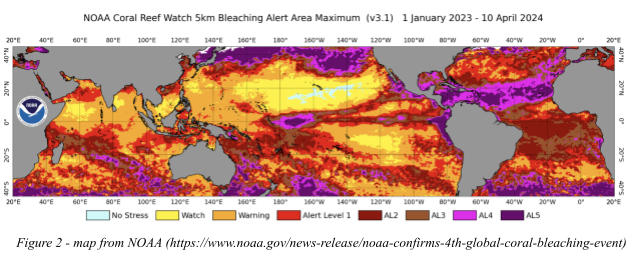
Coral bleaching is one of the main issues presented on the coral reefs. There are several factors that contribute to coral bleaching, but it is mainly correlated with the temperature and pH rise of the ocean. Corals are extremely sensitive to temperature fluctuations, meaning that bleaching can result from a prolonged rise of just 1-2°C beyond their normal thermal threshold. Their normal temperature fluctuates between 23 °C to 29 °C and their pH within 7.8 to 8.4, making any drastic changes in these factors harmful to the corals. Climate change has increased the frequency and intensity of maritime heatwaves, leading to widespread bleaching occurrences. The image showcases the reef that are at risk of bleaching or have been bleached. The NOAA (National Ocean and Atmospheric Administration) states that bleaching events are going to become more frequent, damaging the fragile coral reefs. But, even if the coral is bleached, it has the potential to bounce back, becoming healthy and restoring its role in the reef.
Coral bleaching happens when the rising ocean temperatures and pH changes in the water stress the algae (zooxanthellae) living in the coral. The symbiotic relationship between the algae and the corals is possible due to the protection the coral gives to the algae. When that protection is no longer possible due to changes in the ocean environment, the algae leave, depriving the coral of its color and energy. However, the algae may reappear and the coral's health may be restored if the ocean conditions improve. [2, 5, 6, 8, 11, 13, 14, 20]
Pollution and Tourism
As corals become increasingly vulnerable, plastic pollution takes a toll. Plastic debris becomes lodged on coral branches as it enters the ocean. According to studies, corals that come into touch with plastic waste have a far higher chance of developing illnesses like white syndrome and skeletal eroding
band, which raises their mortality rates. In addition to weakening individual coral colonies, the physical harm brought on by plastic debris also lowers the structural complexity of reefs, which is essential for offering a variety of marine life habitats. Because of the chemical composition of certain plastics found in the ocean, it takes them decades to decompose. Plastic is not the only thing that harms the ocean, as the emission of methane and greenhouse gases contributes greatly to climate change, causing the temperature and pH of the ocean to rise.

Although tourism is what causes the Maldives to thrive economically, it harms corals. It happens when tourists go scuba-diving and snorkeling around corals, and if they are not careful, their fins can hit the corals, causing damage. Additionally, irresponsible boating over the coral reefs can cause the motor to hit the reef, as corals can be found close to the surface. Despite this case not being as significant, it happens frequently enough to find dead fragment populating the ocean floors. [4, 10, 13, 15, 18, 19]
Efforts to restore the coral reefs
Although efforts to restore coral reefs are still underway, there is optimism thanks to initiatives like Feridhoo's Coral Restoration Project. Reef regeneration has been greatly aided by their creative use of coral transplantation, pyramid-like structures, and ecotourism-driven conservation. A group of 9 students (author’s of the article included) had the honor of collaborating with the Coral Restoration Project team and getting our hands dirty in conservation work.
We participated in beach clean-ups during our trip, eliminating dangerous plastic debris that could endanger marine life. Attaching coral fragments for growth while scuba diving was a rewarding experience. We also measured pieces of coral to monitor their growth.
We learned from this experience how crucial local and international conservation initiatives are to preserving these delicate ecosystems. An encouraging illustration of how direct action, community engagement, and scientific inquiry might help halt coral deterioration is the work being done in Feridhoo. Supporting and growing these restoration projects is essential as human activities and climate change continue to endanger marine life. [9, 17, 21]
Works Cited
[1] “6 Profile and Status of Coral Reefs in Maldives and Approaches to Its Management by Abdulla Naseer1.” Fao.org, 2024, www.fao.org/4/x5627e/x5627e0a.htm. Accessed 15 Nov. 2024.
[2] Allison, Nicola, et al. “Resolving the Interactions of Ocean Acidification and Temperature on Coral Calcification Media PH.” Coral Reefs, 18 Aug. 2021, https://doi.org/10.1007/s00338-021-02170-2.
[3] Blue Marine Foundation. “Maldives.” Blue Marine Foundation, 2023, www.bluemarinefoundation.com/projects/maldives/.
[4] “Climate Change Threatens Maldives’ Fisheries and Tourism, Urgent Adaptation Needed.” IFC, 2024, www.ifc.org/en/pressroom/2024/climate-change-threatens-maldives-fisheries-and-tourism-urgent-adaptation-needed.
[5] CSIRO. “From Larvae to Livelihoods: Restoring Coral Reefs in the Maldives.” Www.csiro.au, 22 Aug. 2023, www.csiro.au/en/news/all/articles/2023/august/restoring-coral-reefs-maldives.
[6] Cyronak, Tyler, et al. “Diel Temperature and PH Variability Scale with Depth across Diverse Coral Reef Habitats.” Limnology and Oceanography Letters, vol. 5, no. 2, 20 Dec. 2019, pp. 193–203, https://doi.org/10.1002/lol2.10129.
[7] “Feridhoo Coral Restoration Project.” Coral Restoration, 2023, www.coralrestorationferidhoomaldives.org/. Accessed 15 Nov. 2024.
[8] Fisheries, NOAA. “Coral Recovery after Bleaching Event in the Central Pacific | NOAA Fisheries.” NOAA, 19 Oct. 2022, www.fisheries.noaa.gov/feature-story/coral-recovery-after-bleaching-event-central-pacific.
[9] Hilmi, Nathalie, et al. “The Pressures and Opportunities for Coral Reef Preservation and Restoration in the Maldives.” Frontiers in Environmental Economics, vol. 2, 17 Mar. 2023, https://doi.org/10.3389/frevc.2023.1110214.
[10] Joyce, Christopher. “Plastic Pollution Is Killing Coral Reefs, 4-Year Study Finds.” Npr.org, 25 Jan. 2018, www.npr.org/sections/thetwo-way/2018/01/25/580227045/plastic-pollution-is-killing-coral-reefs-4-year-study-finds.
[11] McConnell, Tristan. “The Maldives Is Being Swallowed by the Sea. Can It Adapt?” National Geographic, 20 Jan. 2022, www.nationalgeographic.com/environment/article/the-maldives-is-being-swallowed-by-the-sea-can-it-adapt.
[12] National Oceanic and Atmospheric Administration. “How Do Coral Reefs Protect Lives and Property?” Noaa.gov, 2019, oceanservice.noaa.gov/facts/coral_protect.html.
[13] ---. “How Does Climate Change Affect Coral Reefs?” Noaa.gov, National Ocean Service, 20 Jan. 2023, oceanservice.noaa.gov/facts/coralreef-climate.html.
[14] NOAA. “NOAA Confirms 4th Global Coral Bleaching Event | National Oceanic and Atmospheric Administration.” Www.noaa.gov, 15 Apr. 2024, www.noaa.gov/news-release/noaa-confirms-4th-global-coral-bleaching-event.
[15] Pancrazi, Irene, et al. “Active Coral Restoration to Preserve the Biodiversity of a Highly Impacted Reef in the Maldives.” Diversity, vol. 15, no. 9, 1 Sept. 2023, p. 1022, www.mdpi.com/1424-2818/15/9/1022, https://doi.org/10.3390/d15091022.
[16] Patti, Toby B., et al. “Spatial Distribution of Microplastics around an Inhabited Coral Island in the Maldives, Indian Ocean.” Science of the Total Environment, vol. 748, 15 Dec. 2020, p. 141263, www.sciencedirect.com/science/article/abs/pii/S0048969720347926, https://doi.org/10.1016/j.scitotenv.2020.141263.
[17] Pearce, Reagan. “How the Maldives Is Saving Its Coral Reefs.” Earth.org - Past | Present | Future, 15 Sept. 2020, earth.org/the-maldives-is-saving-its-coral-reefs/.
[18] Philipp, Jennifer. “Fighting Plastic Pollution in the Maldives.” The Borgen Project, 23 Aug. 2022, borgenproject.org/plastic-pollution-in-the-maldives/.
[19] Smailes, Janet. “Plastic Pollution, the Coral Effect – Hotelier Maldives.” Hotelier Maldives, 21 Apr. 2022, https://hoteliermaldives.com/plastic-pollution-the-coral-effect/.
[20] “Tropical Reefs Surviving Environmental Stresses: Corals’ Choice of Symbiotic Algae May Hold the Key | NSF - National Science Foundation.” New.nsf.gov, 29 Aug. 2019, new.nsf.gov/news/tropical-reefs-surviving-environmental-stresses.
[21] Unit, Biosafety. “Main Details.” Www.cbd.int, www.cbd.int/countries/profile?country=mv.


Comments